SK400VOP Embedded SIP Stack
SK400VOP is a performance- and memory-optimized SIP user-agent stack designed from the ground up for embedded communications products. It is intended for teams that need direct control over signaling, networking and media integration without pulling a desktop-class communications framework into the target.
Request licensing information · Read the developer documentation
Why SK400VOP
Many embedded voice products need standards-based SIP interoperability but operate under tighter memory, platform or integration constraints than a conventional softphone. SK400VOP addresses that problem with a compact C implementation and callback-oriented interfaces for signaling events, network transport and media handling.
The stack can be integrated with an OS/RTOS through a mapping layer, or used with ZMATRIX's cooperative-kernel approach for highly constrained targets. Application code remains responsible for platform-specific networking and media capture/rendering, keeping the SIP component portable across products.
Core capabilities
- SIP, SDP, RTP and RTCP
- UDP, TCP and TLS transports
- IPv6 support
- SHA-256 and MD5 authentication
- Optional SRTP/SRTCP and other application-specific extensions
- Multiple SIP accounts, limited by target resources
- Video signaling support
- Auto-answer behavior for paging and public-address applications
- Compact signaling, media and network callback interfaces
- OS/RTOS portability through an abstraction/mapping layer
- Ability to operate without a conventional OS when integrated with the supported cooperative-kernel model
Designed for constrained systems
The current implementation has a stated runtime footprint below 200 KB for code and data in its target configuration. Actual footprint depends on toolchain, build options, enabled features and target architecture, so ZMATRIX recommends validating memory usage against the intended deployment profile.
That compact design can be useful when SIP is one subsystem inside a larger embedded product rather than the product's entire software environment.
Application areas
Radio over IP and dispatch
SIP and RTP are used in a variety of radio-to-IP and dispatch architectures. SK400VOP's explicit media and networking interfaces make it suitable as a signaling component in purpose-built radio gateways, control-room endpoints and related voice systems. See Radio over IP solutions.
Paging, intercom and public address
Auto-answer support and application-controlled media handling fit embedded paging, intercom and announcement endpoints where calls are established programmatically and rendered through dedicated audio hardware.
Embedded handsets and terminals
The stack can be integrated into handheld, wall-mounted or appliance-style endpoints where the product team controls the UI, audio path and network environment.
Legacy communications modernization
SK400VOP can act as the IP signaling layer in gateways that connect older analog or proprietary voice equipment to SIP-based systems. See legacy PSTN-to-SIP integration.
ED-137 implementation history
SK400VOP includes implementation work targeting EUROCAE ED-137B, historically used for VoIP interoperability in Air Traffic Management applications. ED-137B has since been superseded by later ED-137C publications, so projects requiring current ED-137 interoperability should contact ZMATRIX to discuss the exact target revision, required features and validation scope.
This distinction matters for aviation projects: implementation against a historical revision should not be treated as certification or as automatic compliance with later revisions.
Integration model
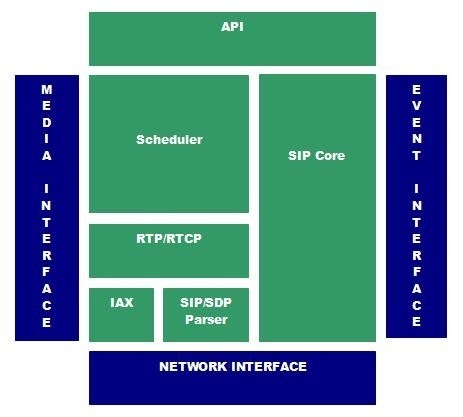
SK400VOP exposes three principal integration surfaces:
- Signaling API and events — application calls for initiating actions plus callbacks for signaling events.
- Network callbacks — target-specific wrappers create network endpoints and send/receive signaling data.
- Media callbacks — the application controls media capture, encode/decode, packet handling and rendering.
This division allows the same signaling implementation to move between different operating systems, network stacks and media pipelines. The developer documentation describes the API and callbacks in more detail.
Commercial licensing and evaluation
SK400VOP remains available for commercial licensing. ZMATRIX has previously licensed the stack commercially, and new engagements can be scoped around the target product rather than assuming a generic one-size-fits-all package.
A licensing discussion can cover:
- target processor, operating system or RTOS;
- required SIP transports and authentication modes;
- IPv4/IPv6 requirements;
- codec/media integration responsibilities;
- source-code availability and permitted modification scope;
- porting or integration assistance;
- product-specific signaling or interoperability work;
- maintenance/support expectations.
For a new product, contact sales@zmatrix.pk with a short description of the target platform and expected call flows.
Technical guides
If you are evaluating the architecture before discussing a license, these guides cover common embedded integration questions:
- How to design an embedded SIP stack integration
- Running SIP on RTOS and bare-metal targets
- Radio over IP gateway architecture
- ED-137 and SIP-based Radio over IP
When SK400VOP is a good fit
SK400VOP is most attractive when SIP is one subsystem inside a purpose-built product and the engineering team wants to retain control over the rest of the system. Typical signals include:
- memory or storage constraints that make a larger framework undesirable;
- a custom media path that should not be dictated by the SIP library;
- an RTOS, embedded Linux or specialized execution environment;
- an existing product that needs SIP added without a major architecture rewrite;
- a radio, paging, intercom or gateway application with unusual call-control behavior.
For a conventional desktop or mobile softphone where footprint and platform control are not important, a larger general-purpose communications framework may be a more natural choice.
Licensing FAQ
Is SK400VOP open source?
No. SK400VOP is offered as commercial software. Contact ZMATRIX for the licensing model applicable to your product and whether source availability is required for your engagement.
Can ZMATRIX port the stack to a new target?
Porting and integration assistance can be included in a commercial engagement. The effort depends primarily on the target's socket/network interface, tasking model, timers and media pipeline.
Does the stack include audio codecs?
SK400VOP separates signaling/media transport from the application's codec and device implementation. The application integrates the codecs and media I/O appropriate to the product through the media callback interface.
Can it be used in an OS-less environment?
The architecture supports an OS-less integration model when combined with the supported cooperative-kernel approach and required platform mappings. Confirm the exact target and timing/network requirements during technical evaluation.
How do we evaluate API fit before licensing?
Start with the developer documentation and send the target platform, required SIP features, expected call flows and media architecture to sales@zmatrix.pk.